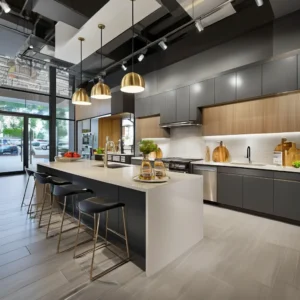
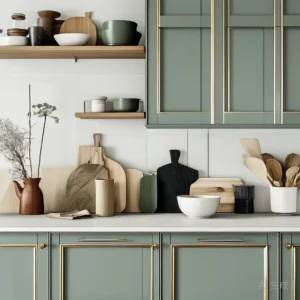
I stood in a newly handed-over Dubai villa three years ago, watching the facilities manager run his hand along the edge of a kitchen cabinet door. The door had swollen just enough to catch against the frame. The veneer had begun to lift along the bottom edge, revealing the substrate beneath. The kitchen looked immaculate at first glance, but up close, it told a different story. The cabinets had not survived their first Gulf summer. The developer was already facing a defect claim across eighteen villas in the same community. The root cause was not poor workmanship. It was a specification that had been written for a European project and applied without modification to a Middle Eastern one.
Kitchen cabinets in the Gulf region face conditions that cabinets in London or Berlin never encounter. Outdoor temperatures exceed 45°C for weeks at a time. Indoor air conditioning creates constant thermal cycling between day and night. Coastal humidity in Dubai, Abu Dhabi, and Doha hovers above 80% for much of the year. Cleaning staff use strong chemical products daily in luxury residential and hospitality projects. And yet, a surprising number of kitchen cabinet specifications for Middle East projects are adapted from European templates, with little consideration for what the local environment actually demands. This guide explains how to specify kitchen cabinets that survive and perform in the Gulf, drawing on lessons learned from projects where the cabinets failed—and from projects where they did not.
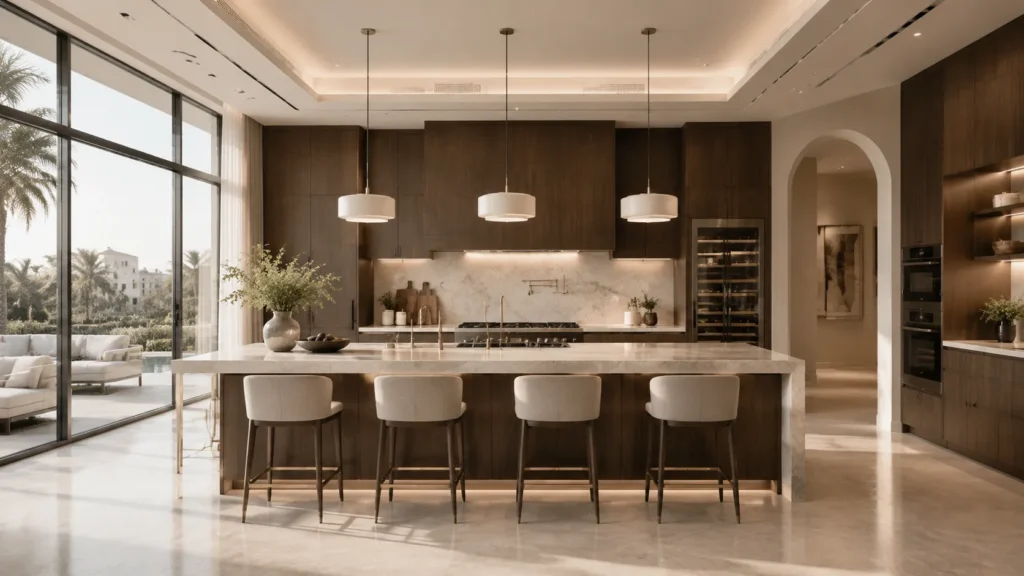
1. The Climate Challenge: What Gulf Conditions Do to Kitchen Cabinets
The Middle East kitchen environment is uniquely aggressive. Understanding the specific mechanisms that cause cabinet failure is the first step to specifying against them.
Thermal Cycling and Material Movement
Kitchen cabinets in Gulf homes experience daily temperature swings that most European and North American cabinets never face. During the day, when residents are at work, air conditioning may be set to a maintenance level or turned off entirely. Indoor temperatures can rise well above 30°C. In the evening, the AC returns to full operation, and the indoor temperature drops to 20°C or lower within an hour. This cycle repeats 365 days a year.
Wood and wood-based panels expand and contract with temperature and humidity changes. The rate of expansion differs between the substrate, the adhesive, and the surface finish. Over thousands of thermal cycles, these differential movements weaken glue bonds and create micro-gaps at joints. A cabinet door that fits perfectly on installation day may bind, warp, or delaminate within two to three years—not because the materials were defective, but because they were not selected for the thermal environment they actually inhabit.
Humidity: The Coastal vs. Inland Divide
Coastal Gulf cities—Dubai, Abu Dhabi, Doha, Muscat, Bahrain, Kuwait City—experience extreme humidity from June through October. Outdoor relative humidity regularly exceeds 85%, and indoor humidity, even with air conditioning, sits between 55% and 70% in kitchens where cooking steam adds to the moisture load. Inland cities—Riyadh, Jeddah—are drier but still experience seasonal humidity spikes.
The practical implication is that material specifications must account for sustained high humidity as a baseline condition, not as an occasional deviation. A cabinet substrate that absorbs moisture will swell, and a swollen substrate will delaminate its surface finish. The damage is progressive. Once the surface layer separates from the core, moisture enters more freely, and the failure accelerates. A warranty claim that surfaces in year two almost always traces back to a material decision made at the specification stage two and a half years earlier.
Chemical Exposure and Cleaning Practices
Middle Eastern households and hotel housekeeping teams clean kitchen cabinets more frequently and with stronger products than their European counterparts. Chlorine-based cleaners, degreasers, and disinfectants are standard. These chemicals attack surface finishes through repeated exposure, particularly at the joint between the cabinet door and the cabinet box, where cleaning solution can pool and sit.
A finish that survives occasional wiping with a mild detergent in a European home may degrade within months under the daily chemical exposure of a Gulf hotel or serviced apartment. The specification must account for this by selecting finishes with proven chemical resistance, not just scratch resistance or aesthetic appeal.
2. Material Selection: The Foundation of Gulf-Ready Kitchen Cabinets
The substrate material is the single most important decision in specifying kitchen cabinets for the Middle East. Everything else—the finish, the hardware, the installation method—depends on getting the substrate right.
The Substrate Hierarchy for Gulf Conditions
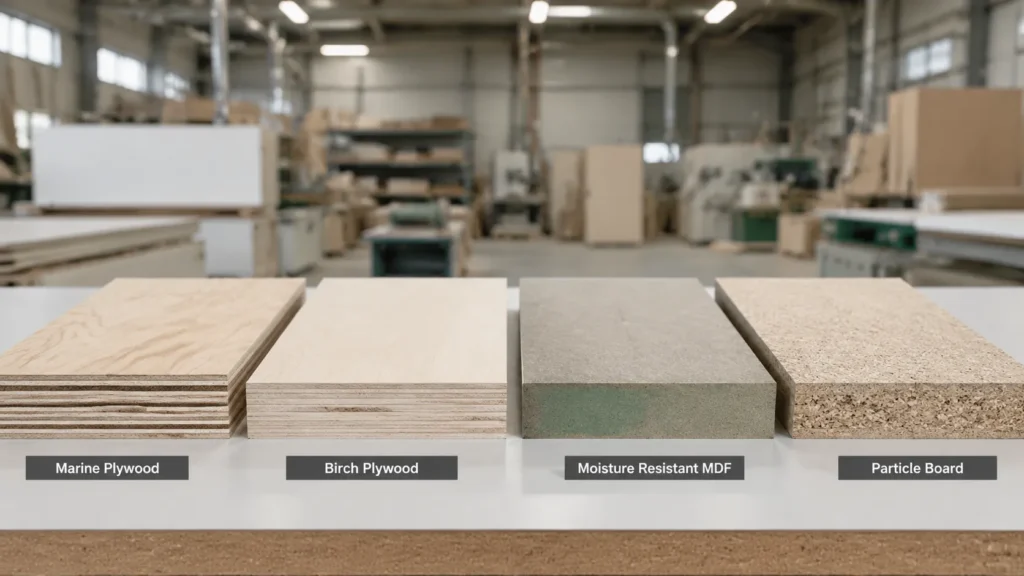
Marine-grade plywood is the top-tier substrate for kitchen cabinet boxes in Middle East projects. It uses exterior-grade adhesive throughout its laminate structure, which means the glue bonds do not break down under sustained humidity. A properly sealed marine ply cabinet box will not delaminate, warp, or swell under Gulf conditions for the service life of the kitchen. For luxury residential and five-star hospitality projects, this is the baseline specification. The cost premium over standard plywood is approximately 30% to 40%, which on a per-unit basis for a typical villa kitchen represents a marginal increase that eliminates a significant source of warranty risk.
Birch-faced exterior-grade plywood is the practical alternative for mid-to-upper-tier projects. It uses the same exterior-grade glue as marine ply, but the face veneer is birch rather than tropical hardwood, and it may have fewer laminate layers. It performs well in all but the most extreme humidity conditions and costs approximately 15% to 25% less than marine ply. For kitchens in inland locations—Riyadh, Al Ain—this material provides adequate durability. For coastal projects, marine ply remains the safer specification.
Moisture-resistant MDF (MR-MDF) is acceptable for painted cabinet door fronts in well-ventilated kitchens with moderate humidity. It is not suitable for the cabinet box itself, and it is not suitable for coastal projects where sustained humidity exceeds 70%. MR-MDF uses a moisture-resistant resin that slows water absorption, but it does not prevent it. In a Dubai villa kitchen, I have seen MR-MDF cabinet boxes swell at the cut edges within two years of installation. If the project requires a painted finish, use MR-MDF for the door and drawer fronts only, and specify marine ply or exterior-grade plywood for the cabinet box.
Standard MDF and particle board have no place in Middle East kitchen cabinets. These materials absorb moisture freely and will fail within the first year in any Gulf location. They appear in low-cost fit-outs and rental properties where the developer accepts a short lifecycle, but for any project with a defects liability period of twelve months or more, they represent an unacceptable risk.
Substrate Selection by Project Type and Location
| Project Type / Location | Cabinet Box | Door and Drawer Fronts |
|---|---|---|
| Luxury Villa / Palace (Coastal) | Marine Plywood | Marine Plywood with Veneer or Lacquer |
| Luxury Villa (Inland) | Marine Plywood or Birch Exterior Plywood | Birch Plywood with Veneer or Lacquer |
| Hotel / Hospitality (Coastal) | Marine Plywood | MR-MDF with High-Durability Lacquer |
| Mid-Range Residential (Inland) | Birch Exterior Plywood | MR-MDF with Lacquer |
| Serviced Apartments | Birch Exterior Plywood | MR-MDF with Laminate |
| Budget / Short-Term | Moisture-Resistant Particle Board (Minimum) | Laminate on MR Substrate |
3. Surface Finishes for Gulf Kitchens
The surface finish on kitchen cabinet doors and exposed panels faces a three-way assault: high humidity, thermal cycling, and aggressive cleaning chemicals. The finish must withstand all three simultaneously.
The Finish Hierarchy
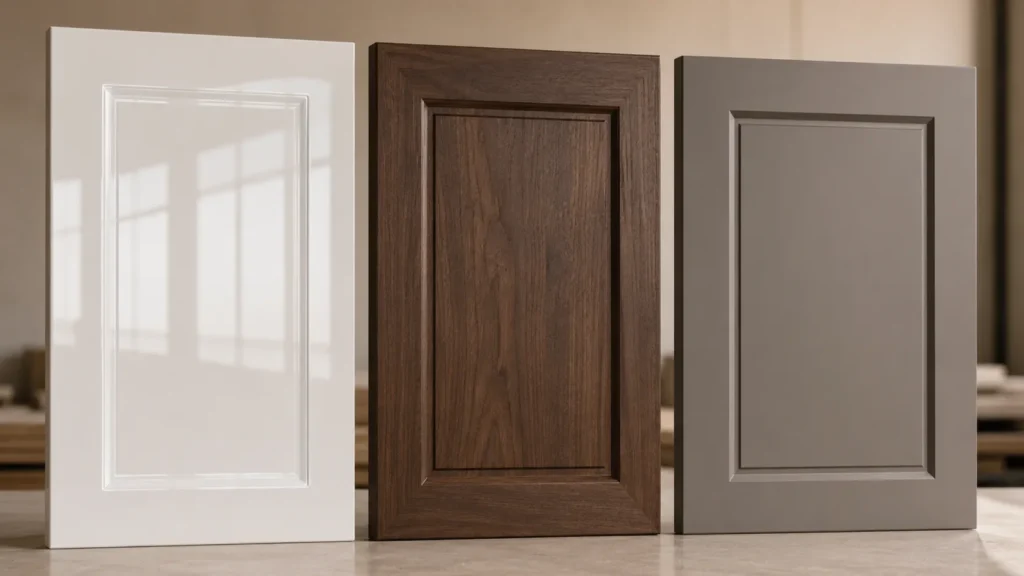
High-pressure laminate (HPL) is the most durable surface finish for kitchen cabinets in Gulf conditions. It is a thermosetting resin-impregnated paper layer pressed onto the substrate under high heat and pressure. HPL resists moisture, heat, impact, and most household chemicals. It does not delaminate under thermal cycling, and it cleans easily with standard cleaning products. For hotel kitchens, serviced apartments, and high-use residential kitchens, HPL is the preferred specification. The design limitation is that HPL is available in solid colors and printed patterns, but it cannot replicate the depth of a real wood veneer or a high-gloss lacquer.
Thermoplastic foils and edge banding are widely used across mid-range kitchen cabinets globally, but they carry specific risks in Gulf conditions. The adhesive that bonds the foil to the substrate softens under sustained high temperatures. On cabinet doors located near ovens, dishwashers, or direct sunlight through glazed façades, foil edges can peel away from the substrate. This is a common callback item in Gulf projects and is almost always caused by thermal degradation of the adhesive, not by mechanical damage. If specifying foil-faced cabinets, verify the adhesive’s temperature rating. The bond must remain stable at surface temperatures of at least 70°C to survive the combination of appliance heat and ambient Gulf climate.
High-gloss acrylic and lacquer finishes are popular in luxury Gulf kitchens because they create the mirror-like reflective surface that Middle Eastern clients often prefer. These finishes are typically applied over an MR-MDF substrate and polished to a high sheen. The quality depends entirely on the number of coats and the curing process. A two-coat acrylic with a UV-cured top layer will resist scratching and chemical attack better than a single-coat lacquer. The specifier should request the finish thickness and the curing method from the manufacturer. A high-gloss kitchen that looks perfect on day one but develops micro-scratches and clouding within six months of housekeeping cleaning is a recurring defect in Gulf luxury projects.
Natural wood veneer is specified for high-end residential projects where the client wants the warmth and authenticity of real wood. Veneer performs well in Gulf kitchens when properly sealed with a catalyzed lacquer or polyurethane topcoat. The veneer itself should be selected from stable species—oak, teak, and walnut are common and reliable. Avoid veneers with high movement rates, such as beech or maple, which will telegraph movement through the finish layer over time.
4. Hardware: The Invisible Difference Between Cabinets That Last and Cabinets That Don’t
Cabinet hardware—hinges, drawer slides, handles, and connecting fittings—is the most frequently overlooked element of kitchen cabinet specification for Middle East projects. When hardware fails, the cabinet door sags, the drawer sticks, or the handle loosens. None of these failures are structural, but all of them generate maintenance calls.
Hinges and Drawer Slides
Soft-close hinges and full-extension drawer slides are standard in mid-to-upper-tier kitchen cabinets globally, and they are expected in Gulf projects. The hardware must resist corrosion from humidity and chemical cleaning. Stainless steel or coated steel mechanisms perform well. Standard steel with a thin zinc plate, on the other hand, will rust within two years in coastal locations.
For heavy cabinet doors—tall pantry doors, integrated appliance doors, doors with thick solid wood panels—the hinge specification must account for the door weight. A standard hinge rated for a 5 kg door will fail prematurely if installed on an 8 kg door with a heavy handle. The specifier should verify the hinge load rating against the actual door weight, including the handle.
Handles and Knobs
Handle finish matching is a significant expectation in Gulf luxury projects. The cabinet handles must match the kitchen faucet finish, the light fixture finish, and often the door hardware finish throughout the apartment or villa. PVD-finished handles in brushed brass, gold, rose gold, and matte black are common in high-end projects. Electroplated handles in the same colors will discolor and pit within eighteen to twenty-four months. The specification should explicitly call for PVD or solid stainless steel handles, and the purchase order should not allow substitution without written approval.
Connecting Fittings and Assembly Hardware
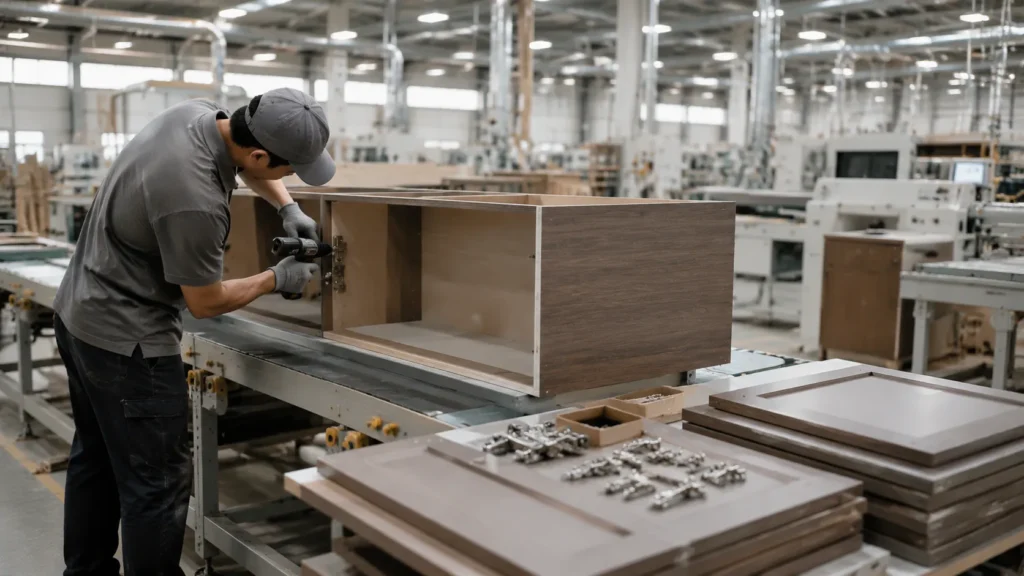
The screws, dowels, and cam locks that connect cabinet panels to each other are hidden from view but critical to structural integrity. These components must be corrosion-resistant. Stainless steel or coated steel is acceptable. Uncoated steel will rust, expand, and crack the surrounding substrate over time. This failure mode is slow, silent, and invisible until a cabinet panel begins to separate at a joint. Replacing a corroded connector inside an assembled cabinet is far more labor-intensive than specifying the correct connector at the procurement stage.
5. Installation Considerations Unique to Middle East Sites
Kitchen cabinet installation in Gulf projects involves several factors that European installation guides rarely address.
Wall Construction and Fixing Methods
Many Middle Eastern residential projects use block-work walls with a plaster or render finish. This construction type provides excellent load-bearing capacity for wall-mounted cabinets, but it requires the correct fixings. Expanding anchors or chemical anchors are standard. Plastic wall plugs, which are common in European stud-wall installations, are not adequate for heavy wall-mounted cabinets in block-work walls. The fixing specification should be verified by the structural engineer or the cabinet supplier’s technical department for the specific wall type.
Clearance for Thermal Expansion
Cabinets installed in Gulf kitchens need slightly larger expansion gaps than in temperate climates. A 2 mm to 3 mm gap between cabinet panels and adjacent walls accommodates the thermal expansion that occurs when the air conditioning is off and the room heats up. Cabinets fitted flush against a wall with no gap may bow or crack at the joint when the building cools and the materials contract. This is a subtle detail that is easy to overlook during installation and expensive to correct after the countertop has been templated and installed on top of the cabinets.
Coordination with MEP Services
Kitchen cabinet installation must coordinate with the mechanical, electrical, and plumbing services that run behind and through the cabinets. Gas supply lines, water supply lines, electrical outlets for appliances, and lighting cables all need to be routed to the correct positions before the cabinets are installed. In many Gulf projects, the MEP rough-in and the cabinet installation are handled by different subcontractors, and the coordination between them is the main contractor’s responsibility. A coordination meeting with both subcontractors before the MEP rough-in begins can prevent the most common interface problems: gas outlets in the wrong position for the hob, electrical outlets blocked by the cabinet back panel, and sink waste pipes that do not align with the cabinet cutout.
6. Fire Safety and Regulatory Compliance
Fire safety regulations in the Gulf region have tightened significantly over the past decade, driven by revisions to the UAE Fire and Life Safety Code of Practice and equivalent codes in Saudi Arabia, Qatar, and other Gulf states.
The Relevant Codes
In the UAE, kitchen cabinets fall under the interior finish provisions of the Fire and Life Safety Code. Cabinet materials must meet minimum flame spread and smoke development ratings. For high-rise residential and hotel projects, the requirements are more stringent than for low-rise villas. The specifier should request fire test certification from the cabinet manufacturer for all materials used in the cabinet construction—substrate, finish, edge banding, and adhesives. A manufacturer that cannot provide this documentation for the Gulf market is either not testing to the required standard or is relying on European certifications that may not be accepted by local civil defense authorities.
Practical Compliance Strategies
The most reliable compliance strategy is to specify cabinets from manufacturers who have already obtained Gulf market fire certification for their products. These manufacturers have tested their complete cabinet assemblies—not just the individual materials—to the relevant standards. If the project requires certification for a specific building height or occupancy type, this must be communicated to the manufacturer before the order is placed, because the certification scope may vary by product line.
Kitchen Extract and Ventilation
Kitchen cabinet specification must also account for the extract ventilation system. Recirculating extractors, which filter air and return it to the kitchen, are common in residential projects but are increasingly restricted by building codes in the UAE and Saudi Arabia. Ducted extractors, which exhaust air outside the building, are the preferred solution in new construction. The cabinet above the hob must be designed to accommodate the extract duct, including any fire-rated duct enclosure required by the building code. This coordination between the cabinet supplier, the MEP contractor, and the fire engineer is a critical interface point that is often missed during the design stage and discovered only during installation.
7. Regional Supply Chain and Logistics
The Gulf kitchen cabinet market operates on a supply chain that spans Europe, Asia, and increasingly local manufacturing. Each sourcing route has distinct implications for lead time, cost, and quality.
European Imports
European-manufactured kitchen cabinets are the standard for luxury residential and high-end hospitality projects in the Gulf. German and Italian brands dominate this segment. Lead times are typically eight to fourteen weeks from order to ex-factory, plus three to five weeks sea freight to Gulf ports. European cabinets carry premium pricing but offer established quality control, comprehensive fire certification, and strong brand recognition that Gulf clients value.
The logistics chain requires attention. Cabinets shipped from Europe in standard containers experience significant temperature and humidity fluctuations during transit, particularly during summer months when container interiors can exceed 60°C. The packaging must protect against moisture ingress and thermal expansion. Cabinets that arrive with swollen edges or delaminated surfaces were almost certainly inadequately packaged for the transit conditions.
Asian Supply
Asian-manufactured cabinets, particularly from China, Malaysia, and Vietnam, are increasingly specified for mid-range residential and hospitality projects. Lead times are typically six to ten weeks ex-factory, plus two to three weeks sea freight. Pricing is significantly lower than European equivalents—often 30% to 50% less—but quality control and fire certification require careful verification.
The key risk with Asian supply is inconsistency between the approval sample and the production batch. A factory may produce an excellent sample for approval, then use a lower-grade substrate or a thinner finish on the production run to meet the price point agreed in the contract. Third-party inspection during production and before shipment is a worthwhile investment for any project where the order value justifies it.
Local Manufacturing
Local cabinet manufacturing in the Gulf has grown significantly in the past decade. Factories in the UAE, Saudi Arabia, and Qatar now produce kitchen cabinets to European and local specifications, with lead times as short as four to eight weeks. Local manufacturing eliminates sea freight risk and reduces lead time uncertainty. Quality levels vary significantly between manufacturers, and the specifier should visit the factory and review recent completed projects before selecting a local supplier. Local manufacturers that use imported European or Asian hardware and apply European finishing standards can deliver a product that matches the quality of imported cabinets with a shorter and more reliable supply chain.
8. The Gulf Kitchen Cabinet Specification Checklist
- Substrate specified by location and project type. Marine plywood for coastal and luxury. Birch exterior plywood for inland mid-range. MR-MDF for door fronts only in low-humidity applications. No standard MDF or particle board anywhere in the cabinet structure.
- Surface finish matched to usage intensity. HPL for hotels and serviced apartments. High-gloss acrylic or lacquer for luxury residential with verified coat thickness. Natural wood veneer with catalyzed topcoat for high-end projects. Foil edges verified for thermal stability above 70°C.
- Hardware specified for corrosion resistance and load rating. Stainless steel or coated steel hinges and slides. PVD or solid stainless steel handles. No electroplated components in coastal locations.
- Fire certification obtained from the manufacturer for the complete cabinet assembly. Verified against the relevant UAE, Saudi, or Qatar civil defense code. Documentation provided before the order is placed.
- Wall fixing method verified for the wall construction type. Expanding or chemical anchors for block-work walls. Fixing load ratings confirmed by the structural engineer or manufacturer.
- Expansion gaps specified at 2 mm to 3 mm between cabinets and adjacent walls. Confirmed during installation walkthrough with the cabinet installer.
- MEP coordination meeting held before rough-in begins. Gas, water, electrical, and extract duct positions confirmed and marked on the cabinet layout drawing.
- Packaging specified for sea freight conditions if importing. Moisture-resistant wrapping. Reinforced corner protection. Container loading plan to prevent movement during transit.
- Third-party inspection during production for imported cabinets. Confirmed in the supply contract. Inspection report received before shipment is authorized.
Final Thoughts
Kitchen cabinets for Middle East projects are not simply kitchen cabinets. They are a climate adaptation exercise. The Gulf environment is more demanding than almost any other region where European or Asian cabinet manufacturers routinely supply product. The cabinets that perform best are those where someone on the specification side understood this, selected materials accordingly, and did not treat the Gulf specification as a minor variation on a European template.
The cost difference between a Gulf-ready kitchen cabinet and a standard import is real but modest—typically 15% to 25% on the cabinet package. Spread across the total project value, it is a rounding error. Spread across the defects liability period, it is the difference between zero callbacks and a maintenance team that knows every cabinet hinge in every apartment. For the contractor who absorbs the cost of callbacks, the specification premium pays for itself before the first defect notice expires. For the client who lives with the kitchen for years afterward, the difference is a kitchen that still opens and closes smoothly, still looks as it did on handover day, and still performs without complaint. That is the standard a Middle East project demands, and it is entirely achievable with the right specification.