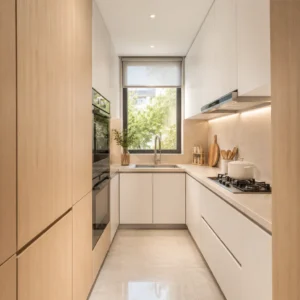
A bathroom cabinet lives in the single harshest environment in the house. It faces daily splashes, steam that condenses behind the doors, temperature swings, and standing humidity that a kitchen cabinet would never tolerate. Pick the wrong material and the doors start to warp within a year; the finish bubbles; the hinges rust. Pick right and a vanity outlasts the faucet. This guide goes past the showroom gloss to the part that actually decides lifespan: the core material and the waterproofing stack built around it — and how to match both to the room the cabinet actually sits in.
Why Bathrooms Destroy Ordinary Cabinets
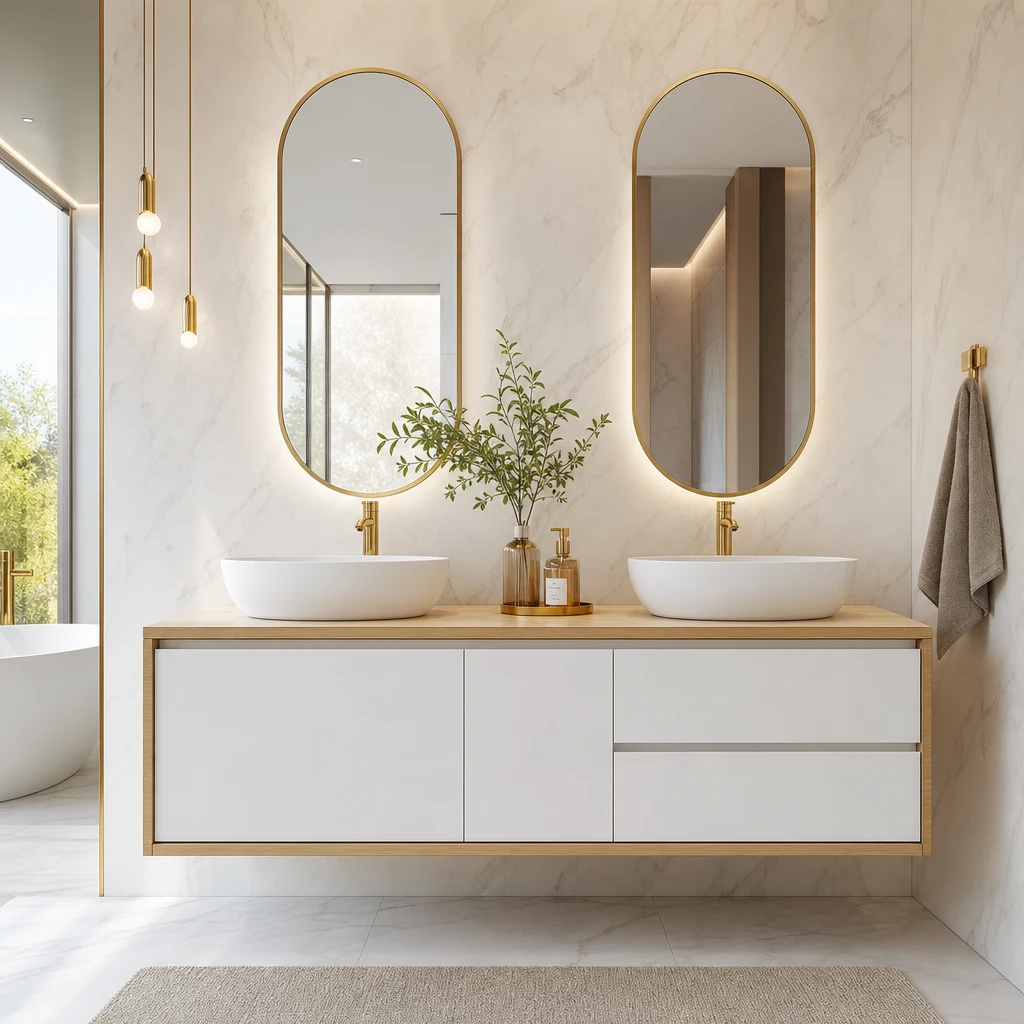
Most cabinet failures in a bathroom are not accidents. They are the predictable result of three forces working together:
- Liquid water — a basin overflows, a supply line weeps, a wet towel drapes over a closed door. Water finds the unsealed edge and wicks into the substrate.
- Humid air — a hot shower pushes relative humidity past 80% and holds it there for an hour every morning. That moisture moves through every unsealed surface, not just the ones you can see.
- Thermal cycling — warm, wet air meets a cool cabinet face and condenses inside the carcass, where it can sit for days between uses.
A kitchen gets one of these at a time, briefly. A bathroom gets all three, repeatedly. That is why a cabinet material that is perfectly fine in a bedroom or kitchen can fail fast in a bathroom — and why “water-resistant” on a spec sheet is not the same as “built for a wet room.” The rest of this guide is about telling the difference.
Bathroom Vanity Core Materials Compared
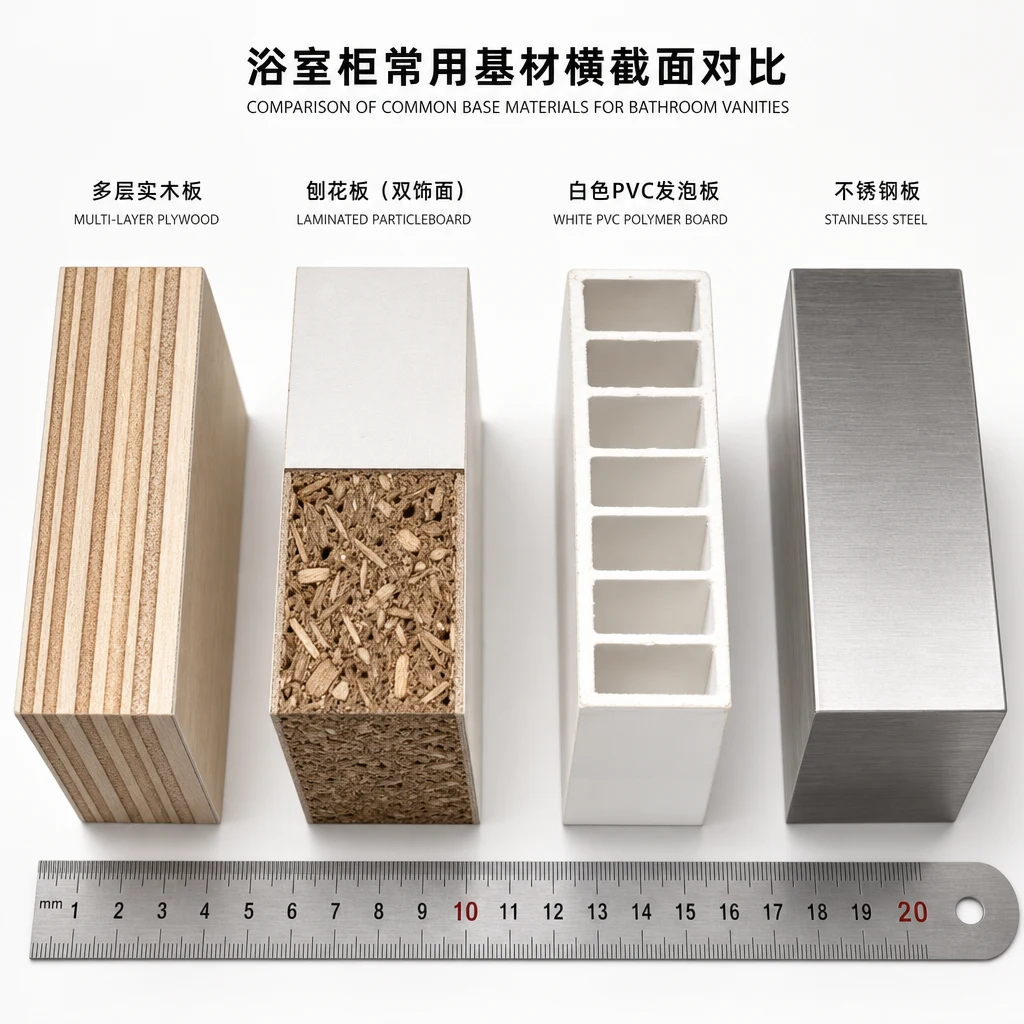
The carcass — the box the doors hang on — is where moisture does its damage, so that is where the material decision matters most. Here is how the common options behave once they meet real bathroom conditions.
| Material | How it handles moisture | Best use | Watch-outs |
|---|---|---|---|
| Multi-layer plywood (E1) | Swells far less than particleboard; holds screws through repeated wet/dry cycles | The default for quality bathroom vanities | Needs sealed edges; specify E1 (low formaldehyde) for indoor air |
| E1 particleboard (laminated) | Acceptable if fully sealed, but absorbs fast once an edge is compromised | Low-budget or low-humidity guest baths | One breach and it balloons; edges are the weak point |
| PVC / polymer board | Essentially waterproof; shrugs off standing water | High-humidity baths, pool houses, rental turnover | Can look less “furniture-like”; thinner premium finish range |
| Stainless steel | Fully impervious; commercial-grade durability | Extreme-humidity or hygiene-critical spaces | Higher cost; can read clinical without warm fronts |
| Solid wood | Beautiful and repairable, but moves with humidity unless heavily finished | Statement pieces in well-ventilated baths | Requires diligent sealing and maintenance |
For most homes, E1-grade multi-layer plywood is the sweet spot: it resists the swell-and-warp cycle better than particleboard, costs less than stainless, and takes a real furniture finish. YIDA specifies E1 board across its cabinet lines and offers matte lacquer, baking paint, and veneer fronts, with moisture-proof core options (PVC or marine-grade substrates) available for the wettest zones. The material alone is not enough, though — what you do to its surfaces is what keeps water out.
The Waterproofing Stack: Beyond the Board
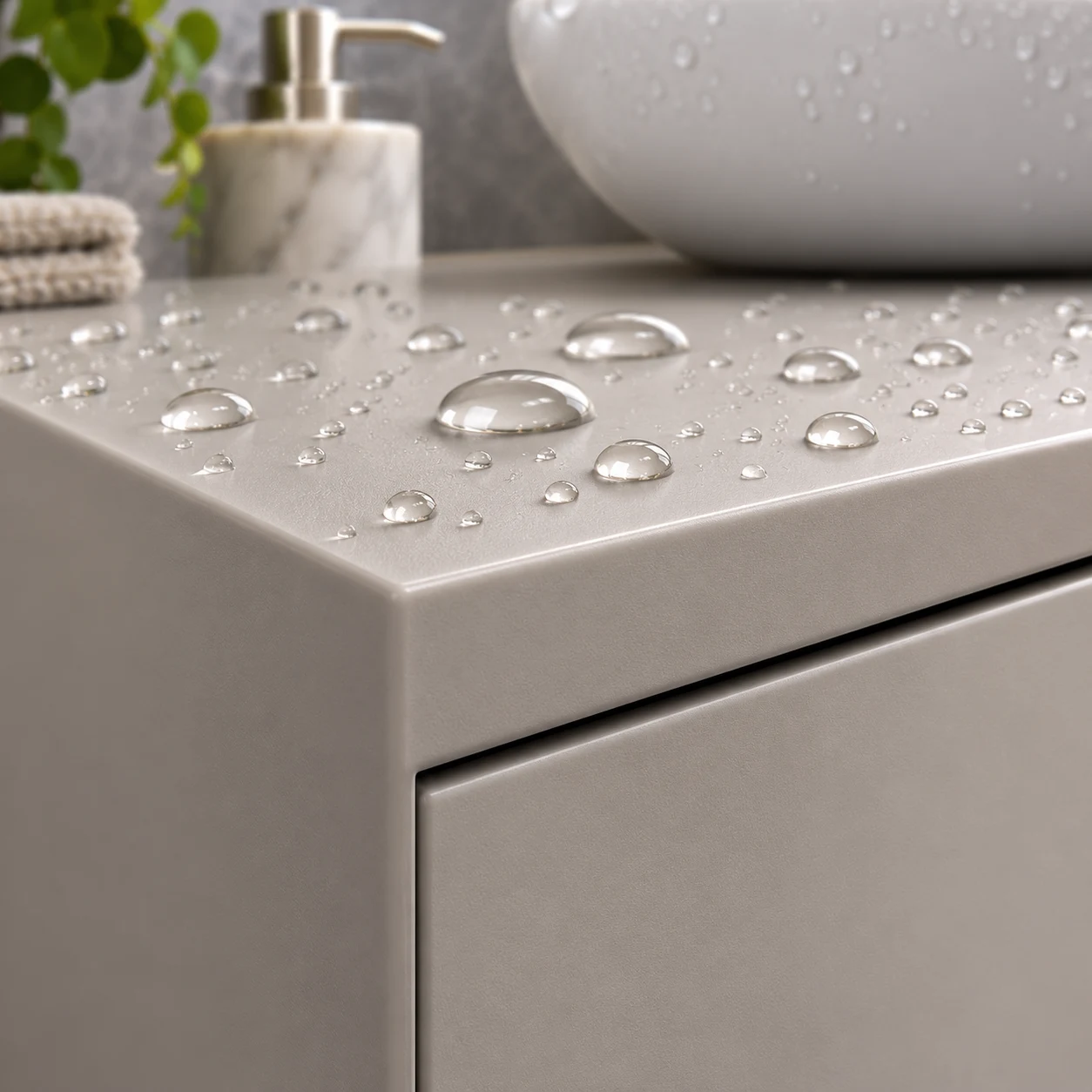
A vanity survives a wet room because of a system, not a single trick. Think of it as a stack of defenses, each covering the gaps the last one leaves:
- Edge banding — this is the single most important waterproofing detail. A board edge is raw substrate; once water reaches it, the clock starts. PUR or laser edge banding seals the perimeter with no glue gap, versus the开放 seams older PVC tape leaves.
- Surface coating — a matte lacquer or 2K baking paint front sheds water instead of absorbing it. In a steamy, high-touch room a matte finish also hides water spotting and fingerprints better than gloss.
- Back and bottom panels — the back of a vanity sits against a damp wall and the bottom collects drips. Sealed backs and a slightly raised, sealed base keep both dry.
- 304-grade hardware — hinges and slides in a bathroom must be stainless or they rust. The Blum-class, OPK, and Nuomi programs YIDA specifies are built for humid air, so doors and drawers keep working instead of seizing.
- Ventilation by design — a wall-mounted (floating) vanity leaves a gap between cabinet and floor where air circulates, so moisture never pools underneath. Even a freestanding unit benefits from a sealed plinth and a small clearance.
None of these is optional in a real bathroom. The trade-offs between hinge and slide types are covered in the hardware and storage systems guide, and the finish behavior day to day is in the kitchen cabinet materials guide — the same principles apply, the stakes are just higher here.
Match the Material to the Room
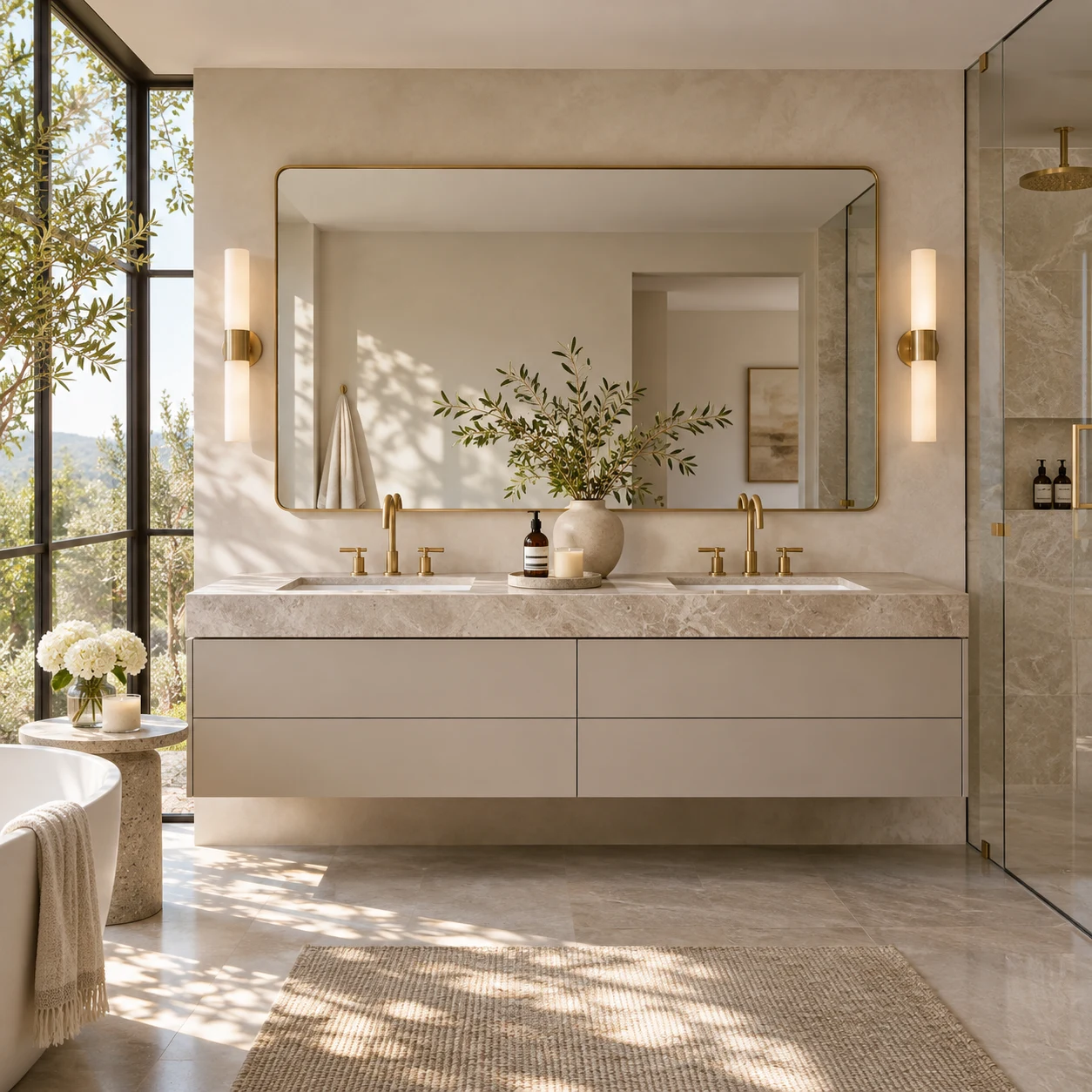
Not every bathroom is equally hostile. Sizing the waterproofing to the actual environment is how you avoid overpaying for stainless in a powder room or under-specifying plywood in a steamy master bath.
| Space | Humidity load | Recommended build |
|---|---|---|
| Master bathroom (shared) | High — two users, daily showers | E1 plywood carcass + matte lacquer/veneer front + stone top + 304 hardware |
| Guest bathroom | Moderate — occasional use | E1 board with sealed edges is sufficient; still specify 304 hinges |
| Powder room / half bath | Low — no shower | Broadest finish choice; moisture-proofing can be lighter |
| Pool house / sauna / rental | Extreme or high turnover | PVC core or stainless; prioritize wipe-clean durability |
If the room is tight, a wall-mounted or corner vanity delivers the function without trapping moisture in a floor gap. For sizing and clearance rules that work around your actual plumbing, the custom bathroom vanity guide covers dimensions and configuration.
Certifications That Matter for Wet Rooms
If the vanity or its fittings ship to a regulated market, the certs on the spec sheet are not decoration — they determine whether the install passes inspection:
| Certification | What it covers | Why it matters for bathrooms |
|---|---|---|
| CUPC | North American plumbing/product compliance | Required for vanity tops, faucets, and related plumbing |
| WaterMark | Australian plumbing compliance | Mandatory for compliant AU bathroom installs |
| SASO | Saudi standards compliance | Needed for KSA projects and shipments |
| CE | European conformity | For EU-bound projects |
| ISO 9001 | Quality management system | Signals consistent manufacturing control |
Raise which of these apply during the design phase, not after production — reworking a shipped batch for a missed cert is expensive and slow.
Bathroom Vanity Buying Checklist
Use this before you approve a quote, whether you buy one vanity or a hundred:
- Ask what the carcass is — “plywood” is not enough; confirm E1 grade and the core type.
- Check the edge banding — PUR or laser, not open PVC tape, on every exposed edge.
- Confirm the finish is a real coating — matte lacquer or 2K paint, not a thin laminate that lifts at the first bubble.
- Specify 304 stainless hardware — rusted hinges are the most common early failure.
- Match the build to the room — don’t over- or under-spec versus the humidity load above.
- Verify the certs for your destination market before production starts.
- Ask about trial assembly — a unit built and checked before shipping catches a misaligned cutout that would otherwise leak behind the basin.
YIDA builds and checks 100% pre-shipment trial assembly, keeping production error rates near 0.1% — a meaningful number in a bathroom, where a miscut drain cutout cannot be hidden behind a backsplash the way it can in a kitchen.
How YIDA Builds Moisture-Resistant Vanities
Because a vanity has to clear plumbing and survive a wet room, YIDA builds it against your actual floor plan rather than a stock size:
- E1 board carcasses with moisture-proof core options for high-humidity zones, finished in matte lacquer, baking paint, or veneer.
- 304-grade hinges and full-extension slides specified as standard for bathroom use.
- 100% pre-shipment trial assembly so cutouts, edges, and fit are verified before anything ships — errors held near 0.1%.
- Built as part of whole-home customization, so the vanity matches kitchen and wardrobe finishes for one coordinated look.
Behind that is a Foshan operation established in 2011 with 80,000㎡ of factory, 10 Industry 4.0 production lines, and capacity above 200,000 units per year across 42,000+ delivered projects — the scale that lets a moisture-resistant spec be consistent batch to batch.
Plan it properly: send your floor plan and bathroom dimensions for a free 3D design that places drain and supply cutouts and storage before production, then confirm configuration, material, and finish. Browse the bathroom vanity collection and the custom bathroom vanity guide to see how a coordinated, moisture-proof bathroom comes together.
Ready to specify your vanities? Send your project details and floor plan via the contact page and receive a 3D design and quotation within 24 hours — built around your real room, your real plumbing, and a material spec that actually survives a wet room.